Every Key Tracked. Every Shift Secured
Structured custody for critical-area keys — authenticated by role, tracked by shift, accountable across every handover.

Structured custody for critical-area keys — authenticated by role, tracked by shift, accountable across every handover.
Structured custody for critical-area keys — authenticated by role, tracked by shift, accountable across every handover.

Managing keys in plant and maintenance environment is complex and challenging. Keys change down across multiple Flexible hours. Contractors arrive with their own authorisations and may not always return issued keys on time. Maintenance supervisors manage dozens of technicians across a facility that operates continuously. In such environments, keys to critical isolation points, restricted storage areas, or high-voltage panels can become unaccounted for.
The consequences extend beyond administration. An untracked key to a restricted area represents a potential access risk. A maintenance key not returned at Shifts end introduces operational and safety concerns. A key board with no record of key usage creates gaps in audit readiness.
Many plants continue to manage this through hook boards, paper registers, and informal processes that rely on experience rather than structured tracking.
KeyKnox addresses this gap by introducing structured key custody and access control, supported by system-based authentication and audit records that track key usage across Shifts, users, and critical areas within the facility.
The KeyKnox Plant & Maintenance Workflow
Eight steps from plant key inventory setup to Flexible hours activity reporting.
Every maintenance and plant key is catalogued, tagged, and assigned a position in the KeyKnox cabinet - mapped to the area, equipment, or system it controls. Access permissions are configured by role, Flexible hours, and authorisation level. Once configured, the system supports structured management of key access and reduces reliance on manual tracking.
At the start of each Flexible hours, technicians authenticate at the KeyKnox cabinet via RFID card / Finger Biometrics/Mobile app. Only the keys relevant to their role and current work authorisation are released. No technician can access keys outside their permitted scope.
Visiting contractors and third-party maintenance teams are issued time-limited access profiles. Keys are accessible only as per defined permissions and usage windows aligned to their work scope. Activity is recorded against user identity to support traceability.
At shift change, the system provides visibility into keys issued and those yet to be returned. Teams can follow structured handover processes supported by time-stamped records, improving clarity and accountability during shift transition.
Keys to restricted areas - chemical stores, high-voltage rooms, confined space access points, and process isolation zones - can be configured to require dual authorisation or supervisor approval before release. The system enforces the control; the procedure does not have to rely on individual compliance.
Any key not returned within the defined window triggers immediate alerts to the keyholder, their supervisor, and the control room or security team. Outstanding key usage can be reviewed through system records and reporting.
Key usage can be aligned with defined maintenance processes and operational workflows, helping improve linkage between maintenance activities and controlled key access.
Key activity reports - including issued keys, returns, outstanding items, and exceptions - can be generated to support shift reviews, handovers, and maintenance records
Hardware, software & mobile platform for the complete key management ecosystem
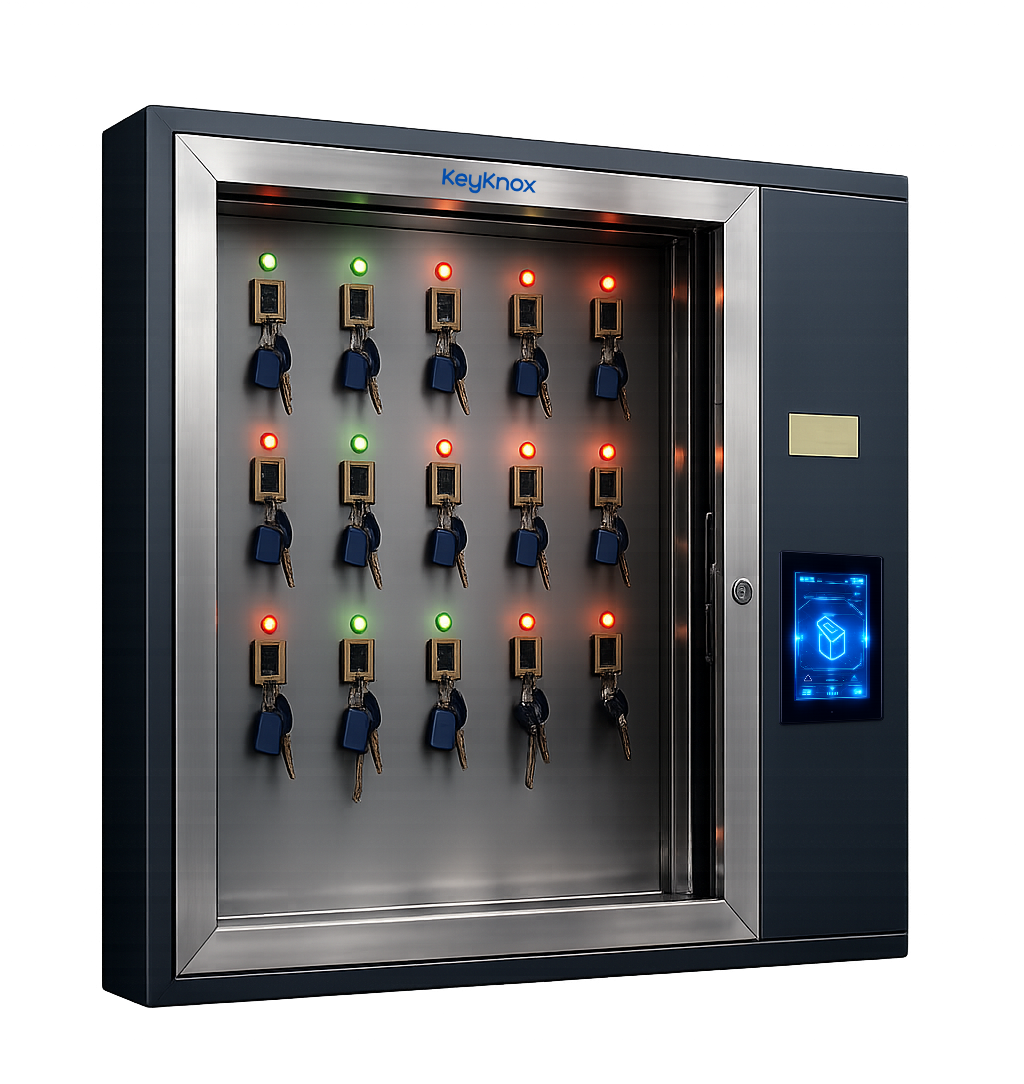
The KeyKnox cabinet is designed for secure storage and controlled access to keys, ensuring traceability and accountability across operations.
2.4-inch TFT display
60,000 events
30,000
TCP/IP, RS485
Mifare Smart Card, HID Multi-technology Card
Available in 16, 32, 64, 96 and 128 keys.
Up to 128 keys per system
Powder-coated mild steel (1 mm)
Polycarbonate / Tuffon Glass door with metal frame.
Electric Motorized Lock
Wall-mounted system
Available on request
Available on request
110V – 240V AC
12 V DC
12V @ 2 Amp

KeyKnox Shield is the centralised software platform used to configure, manage, and monitor key access, cabinet operations, and audit records across multiple locations.
Each transaction is recorded with user identity, timestamp, and action performed.
The system maintains structured logs including:
These records support internal audits, compliance requirements, and incident analysis.
The KeyKnox Shield Mobile App provides a mobile interface for users to access key information and interact with the system as per configured permissions.
Answers about KeyKnox — secure storage, access control, and audit-ready key tracking.
An Electronic Key Management System is a secure solution that helps organizations control, monitor, and track the usage of physical keys. By combining intelligent key storage hardware with centralized management software, the system improves accountability, enhances security, and reduces the risk of lost or unauthorized key access.
Keys are stored within a secured electronic cabinet and assigned to authorized users. Users can access only those keys for which they have been granted permission. Every key transaction is recorded, providing complete visibility into key usage, returns, and access history.
An Electronic Key Management System helps improve security, reduce manual record-keeping, and strengthen accountability. Organizations can monitor key movements, control user access, track overdue keys, and maintain a clear audit trail of all key-related activities.
Access to keys is controlled through user permissions configured by authorized administrators. Depending on organizational requirements, users may be granted access to specific keys, groups of keys, or designated locations.
Yes. The system maintains a record of key transactions, allowing administrators to identify which user accessed a particular key, when it was removed, and when it was returned.
Yes. Administrators can configure access permissions based on organizational requirements. Users can be assigned specific keys or key groups, helping ensure that only authorized personnel have access to designated assets.
Administrators can monitor outstanding key transactions through the management platform. The system helps identify overdue keys and provides visibility into who currently has possession of the key.
Yes. The system provides a centralized management platform that enables administrators to manage users, permissions, key assignments, reports, and operational activities across the organization from a single interface.
Yes. The system maintains activity records related to key usage, user actions, assignments, transfers, and other operational events. These records support internal audits, compliance requirements, and operational monitoring.
Yes. The platform can be used to manage key access operations across multiple locations, helping organizations maintain centralized visibility and control while supporting local operational requirements.
Electronic Key Management Systems are commonly used in corporate offices, manufacturing facilities, logistics operations, educational institutions, healthcare facilities, government organizations, transportation environments, utilities, and other locations that require controlled access to physical keys.
KeyKnox addresses this gap by introducing structured key custody and access control, supported by system-based authentication and audit records that track key usage across Flexible hours, users, and critical areas within the facility.
Book Consultation